
Where India’s forests still hold their nerve
Madhya Pradesh is often called the tiger state, and for good reason. Its forests are among the most important wildlife landscapes in India, home to some of the country’s most celebrated national parks and reserves.
But to understand the wildlife of Madhya Pradesh only through the tiger would be rather like describing India through one spice. Impressive, certainly, but entirely insufficient.
This is a state where forests shift in character from sal and bamboo to teak, grassland, riverine woodland and rocky plateaus. Each landscape carries its own rhythm. Kanha’s sweeping meadows and forest corridors feel expansive, almost cinematic. Bandhavgarh, with its ancient fort and dense forests, carries the drama of both wildlife and history. Satpura is quieter, more layered, rewarding travellers who prefer their wilderness with nuance rather than fanfare. Pench, immortalised in the imagination through the landscapes that inspired Rudyard Kipling’s The Jungle Book, remains a forest of movement, calls and sudden silences.
The tiger may be the headline, but the supporting cast is extraordinary. Leopards move like rumour through the undergrowth. Wild dogs hunt with unnerving intelligence. Sloth bears appear with a shambling dignity entirely their own. Barasingha, gaur, sambar, chital, jackals, crocodiles, raptors, owls, hornbills and countless smaller species complete a wilderness that is far richer than a single sighting.
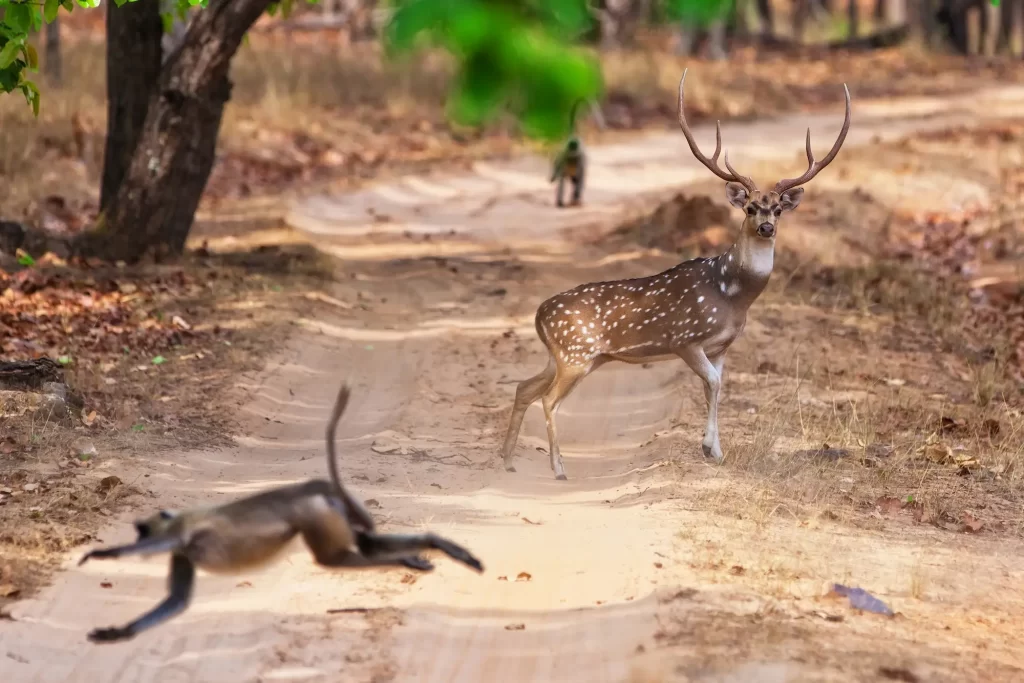
What makes Madhya Pradesh so compelling for the thoughtful traveller is not only the possibility of seeing wildlife, but the chance to understand its habitat.
Here, the best safari experiences are not a race from one sighting to the next. They are exercises in attention. The alarm call of a langur. The sudden stillness of deer. The interpretation of tracks. The change in bird behaviour. The patience of a naturalist who knows that the forest reveals itself only to those willing to wait.
This is where Madhya Pradesh excels. Its lodges and guides have helped move the conversation from wildlife as spectacle to wildlife as story. The finest journeys here are not built around promises of guaranteed sightings, which the forest wisely refuses to provide. They are built around immersion, interpretation and respect.
For travellers from the UK and Europe, Madhya Pradesh offers an extraordinary wildlife circuit that can be designed with depth and variety. One can combine Kanha with Bandhavgarh, Satpura with Pench, or extend into Bori and other lesser-known forest landscapes. Each pairing creates a different mood and ecological perspective.
The reward is not simply the tiger, though few encounters in the wild are more stirring.
The real reward is the feeling of entering landscapes that still hold their nerve. Forests that are alive, intelligent and gloriously indifferent to our schedules.
Which, frankly, is exactly how forests should be.