
Sri Lanka has always possessed the sort of beauty that lends itself to grand narratives. Tea hills wrapped in morning mist, wildlife roaming through monsoon forests, colonial towns facing the Indian Ocean with a languid confidence that only centuries can cultivate. Yet the island’s most compelling stories are rarely discovered through scale. They are found in places that resist spectacle.
Increasingly, the most discerning travellers are discovering Sri Lanka not through sprawling resorts, but through a quieter constellation of intimate boutique hotels. These are places where architecture speaks softly, where landscapes remain the principal attraction, and where hospitality feels less institutional and more personal. To explore Sri Lanka this way is to encounter the island not as a destination, but as a series of finely observed moments.
Landscapes in Miniature: The Distinct Character of Mountain Boutiques
Sri Lanka’s geography shifts with remarkable ease. Within a few hours’ drive the island moves from bird-filled wetlands to cool tea country and onward to mountain ridges that appear suspended in mist. Few hotel collections illustrate this diversity as vividly as Mountain Boutiques, whose properties are deliberately small in scale yet deeply rooted in their surroundings.
Rather than replicating a standardised design language, each hotel within the collection responds directly to its environment. Architecture, materials and spatial layout are shaped by landscape first, aesthetics second. The result is a trio of properties that feel less like a chain and more like carefully observed interpretations of Sri Lanka’s varied terrain.
Flameback Eco Lodge: A Wetland Sanctuary
In the southern reaches of the island, Flameback Eco Lodge in Weerawila offers a very different expression of boutique hospitality. Located beside the tranquil Weerawila Lake within a designated bird sanctuary, the property is conceived as an immersive eco-lodge rather than a conventional hotel.
Accommodation takes the form of luxury tented lodges, an architectural choice that aligns with the surrounding ecosystem. The structures remain deliberately lightweight, allowing the garden landscape and lakeside wetlands to remain the primary spectacle. Canvas, timber and natural textures replace rigid masonry, giving the lodge a softness that sits comfortably within the environment.
The experience here is shaped by sound as much as sight. The early morning chorus of endemic birds forms a natural soundtrack, while the still waters of the lake reflect the surrounding greenery with almost meditative calm.
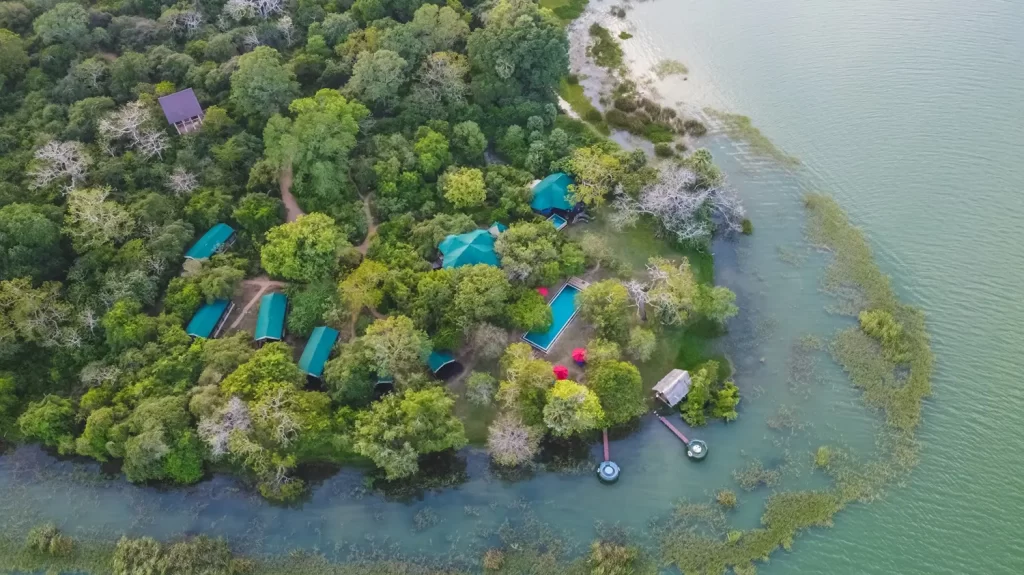
Flameback’s ethos extends to its culinary philosophy as well. The kitchen favours organic ingredients sourced from nearby communities, grounding the dining experience firmly in the local agricultural ecosystem. Meals are simple yet thoughtful, reinforcing the lodge’s broader commitment to sustainability and environmental stewardship.
This is glamping in the truest sense: an encounter with nature that does not compromise comfort.
Rosewood Manor: Tea Country Elegance
Travel northward into Sri Lanka’s lush hill country and the mood shifts dramatically. Here, rolling tea plantations stretch toward the distant ridges of the Sinharaja rainforest reserve, one of the island’s most significant biodiversity hotspots.
Set within this landscape, Rosewood Manor draws inspiration from the architectural language of a traditional country manor house. Unlike the eco-minimalism of Flameback, Rosewood Manor embraces a more classical aesthetic: elegant proportions, carefully detailed interiors and generous verandas that frame sweeping mountain views.
The property sits within a working tea estate, and its design reflects the refined atmosphere historically associated with plantation life. Interiors balance sophistication with warmth, while large windows invite the surrounding greenery into every room.
The cool climate of the region adds another dimension to the experience. Mornings often begin with drifting mist across the hills, gradually revealing the dramatic forested slopes bordering the Sinharaja reserve.
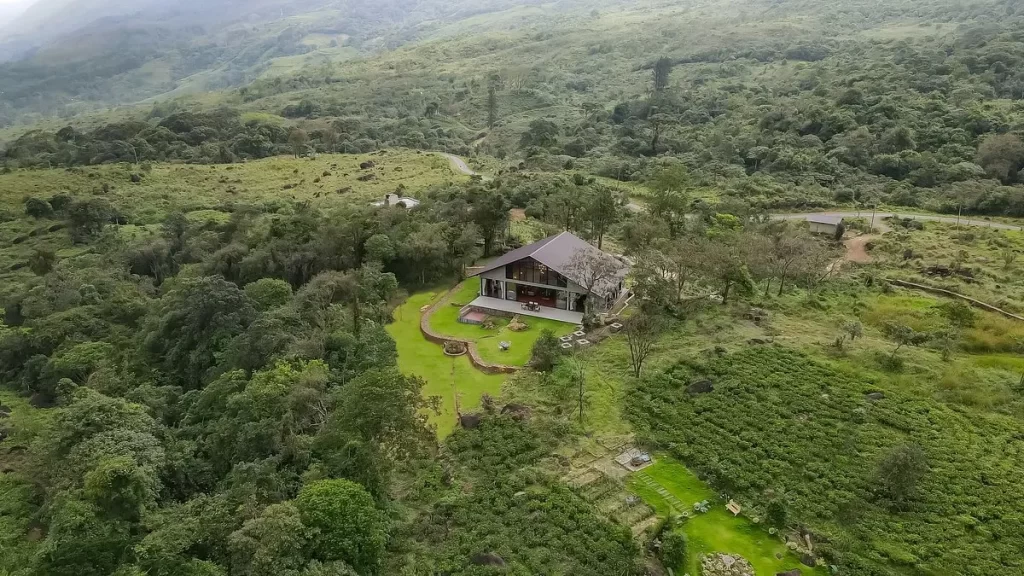
Service here carries the understated formality of a country house retreat. Guests are attended by discreet butlers, while the in-house chef crafts menus that combine Sri Lankan flavours with the comforting sensibilities of estate dining.
The effect is quietly luxurious, allowing guests to feel as though they have stepped into a private residence within the tea country.
Capoe House: The Drama of the Highlands
Perhaps the most visually striking property within the Mountain Boutiques collection is Capoe House, perched high above the dramatic Haputale mountain range.
Here the architecture takes full advantage of the extraordinary elevation. Built along an exclusive cliffside overlooking organic tea estates, the property offers panoramic views across a landscape that appears to unfold endlessly beneath the horizon.
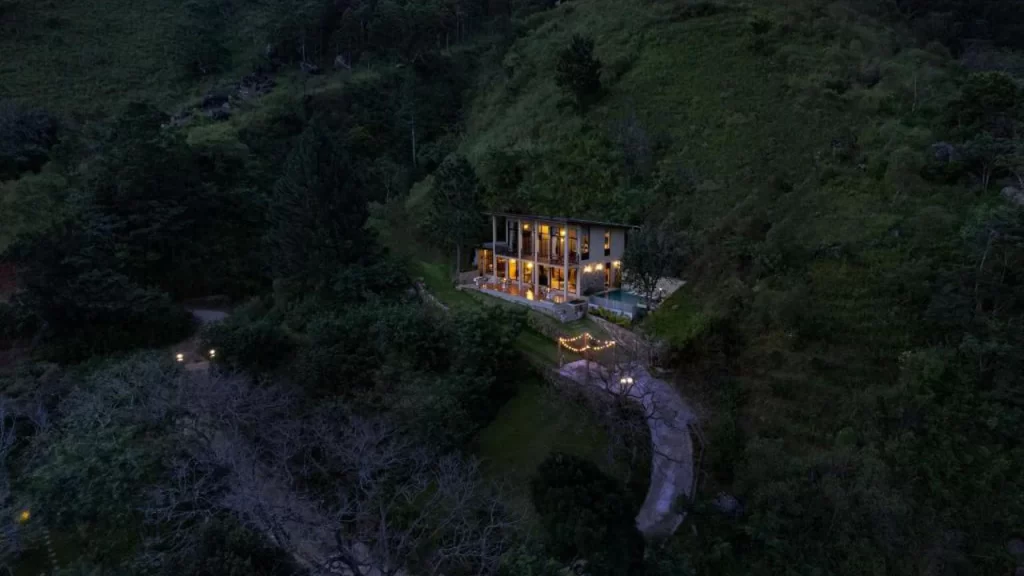
The design philosophy at Capoe House is one of intimate seclusion. Rooms and terraces are positioned to maximise privacy while capturing the sweeping mountain vistas that define Haputale’s reputation as one of Sri Lanka’s most spectacular hill stations.
The climate itself becomes part of the experience. Haputale’s cool mountain air and drifting clouds lend the property an atmosphere that feels almost alpine in character, a striking contrast to the tropical warmth found elsewhere on the island.
Guests spend their days exploring tea estates, watching the light change across the mountains or simply enjoying the rare luxury of silence.
In the evening, the landscape softens again as mist returns to the hills, wrapping the estate in quiet stillness.
The Southern Coast: The Postcard Galle
If the highlands encourage contemplation, Sri Lanka’s southern coast invites a different mood entirely. Here, the ocean defines the rhythm of life. Fishermen set out before sunrise, waves crash steadily against rocky shores, and colonial towns such as Galle retain the faded elegance of another era.
Just outside the historic walls of Galle Fort lies The Postcard Galle, a boutique property that captures the coast’s effortless charm. The Postcard brand is known for its minimalist approach to luxury, and its Sri Lankan outpost follows the same philosophy: small scale, strong design sensibility and a deep respect for place.
Set within lush gardens overlooking the Indian Ocean, the hotel offers a tranquil counterpoint to the bustle of Galle town. The architecture is understated, allowing the sea to remain the dominant presence.
Days here unfold gently. Guests might begin with breakfast beneath swaying palms before wandering into Galle Fort, where Dutch-era streets are lined with antique shops, galleries and cafés. The fort itself feels like a living museum, its ramparts offering views of the ocean that have remained largely unchanged for centuries.
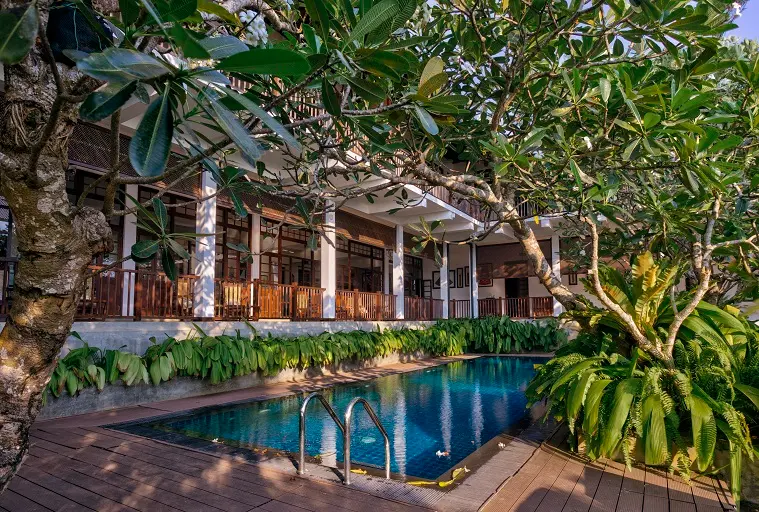
Back at the hotel, the afternoon invites stillness. A swim in the pool, a walk along nearby beaches, perhaps a moment with a book while the sea breeze drifts through open terraces. In the evening, the sky performs its daily theatre as the sun sinks into the Indian Ocean.
The Luxury of Character
What unites our curated list is not simply scale but character. Each hotel reflects its landscape rather than imposing a universal design language upon it.
This approach resonates with travellers increasingly drawn to authenticity over uniformity. Large resorts may offer efficiency and abundance, but boutique hotels offer something rarer: individuality.
In Sri Lanka, this individuality often emerges through architecture and location. The island’s geography allows a traveller to experience remarkable contrasts within relatively short distances. One may wake to mist-covered mountains and by evening arrive at an ocean horizon.
Boutique hotels provide the ideal lens through which to experience these transitions. Their size allows them to exist within landscapes rather than beside them.
Sri Lanka, explored differently
Sri Lanka rewards curiosity. It is an island where the most memorable experiences often occur in unexpected places: a tea estate path at dawn, a conversation with a fisherman repairing his nets, the sudden appearance of a temple hidden among jungle trees.
For travellers seeking to understand Sri Lanka rather than merely visit it, this distinction matters. The island has never lacked beauty. What boutique hospitality reveals is its texture. And it is in these quieter, more intimate settings that Sri Lanka’s character emerges most clearly.